Showing posts with label sustainability. Show all posts

Tuesday, June 24, 2008

Amount of Space...


Figure 2.6: Amount of space required to transport the same number of passengers by car, bus or bicycle. Click here for larger image.


Sunday, April 20, 2008

Why Bother?

Michael Pollan with a wonderful essay in the New York Times arguing for the importance of personal choice in making a difference in the face of climate change (and an argument that can easily be extended to a wealth of other environmental, social, and economic factors). Pollan's essay touches on issues that have long troubled me. Among the positives are framing environmental responsibility as a fundamentally moral choice (albeit, in the positive sense of moral, not the finger-wagging, school-marmish sense) and framing environmentally responsible acts as pleasurable (for me, living in a city, for Pollan, planting a garden and growing your own food). More vexing is how to convince people to embrace personal change when confronted with the overwhelming sense that the problem is too large to impact, or when faced with concerns of developed countries somehow falling behind in a consumer arms race with their counterparts in China (the traditional bogeyman) or elsewhere. And kudos to Pollan for re-raising the profile of Wendell Berry, an essayist who deserves a much wider following. Read on:
For us to wait for legislation or technology to solve the problem of how we’re living our lives suggests we’re not really serious about changing — something our politicians cannot fail to notice. They will not move until we do. Indeed, to look to leaders and experts, to laws and money and grand schemes, to save us from our predicament represents precisely the sort of thinking — passive, delegated, dependent for solutions on specialists — that helped get us into this mess in the first place. It’s hard to believe that the same sort of thinking could now get us out of it.

Thirty years ago, Wendell Berry, the Kentucky farmer and writer, put forward a blunt analysis of precisely this mentality. He argued that the environmental crisis of the 1970s — an era innocent of climate change; what we would give to have back that environmental crisis! — was at its heart a crisis of character and would have to be addressed first at that level: at home, as it were. He was impatient with people who wrote checks to environmental organizations while thoughtlessly squandering fossil fuel in their everyday lives — the 1970s equivalent of people buying carbon offsets to atone for their Tahoes and Durangos. Nothing was likely to change until we healed the “split between what we think and what we do.” For Berry, the “why bother” question came down to a moral imperative: “Once our personal connection to what is wrong becomes clear, then we have to choose: we can go on as before, recognizing our dishonesty and living with it the best we can, or we can begin the effort to change the way we think and live.”

For Berry, the deep problem standing behind all the other problems of industrial civilization is “specialization,” which he regards as the “disease of the modern character.” Our society assigns us a tiny number of roles: we’re producers (of one thing) at work, consumers of a great many other things the rest of the time, and then once a year or so we vote as citizens. Virtually all of our needs and desires we delegate to specialists of one kind or another — our meals to agribusiness, health to the doctor, education to the teacher, entertainment to the media, care for the environment to the environmentalist, political action to the politician.

As Adam Smith and many others have pointed out, this division of labor has given us many of the blessings of civilization. Specialization is what allows me to sit at a computer thinking about climate change. Yet this same division of labor obscures the lines of connection — and responsibility — linking our everyday acts to their real-world consequences, making it easy for me to overlook the coal-fired power plant that is lighting my screen, or the mountaintop in Kentucky that had to be destroyed to provide the coal to that plant, or the streams running crimson with heavy metals as a result.

Of course, what made this sort of specialization possible in the first place was cheap energy. Cheap fossil fuel allows us to pay distant others to process our food for us, to entertain us and to (try to) solve our problems, with the result that there is very little we know how to accomplish for ourselves. Think for a moment of all the things you suddenly need to do for yourself when the power goes out — up to and including entertaining yourself. Think, too, about how a power failure causes your neighbors — your community — to suddenly loom so much larger in your life. Cheap energy allowed us to leapfrog community by making it possible to sell our specialty over great distances as well as summon into our lives the specialties of countless distant others.

Here’s the point: Cheap energy, which gives us climate change, fosters precisely the mentality that makes dealing with climate change in our own lives seem impossibly difficult. Specialists ourselves, we can no longer imagine anyone but an expert, or anything but a new technology or law, solving our problems. Al Gore asks us to change the light bulbs because he probably can’t imagine us doing anything much more challenging, like, say, growing some portion of our own food. We can’t imagine it, either, which is probably why we prefer to cross our fingers and talk about the promise of ethanol and nuclear power — new liquids and electrons to power the same old cars and houses and lives.
Read the rest.

Wednesday, January 30, 2008

You Don't Miss Your Water...

An interesting article from the NYT on how climate change, both in terms of current impact and projected impact, is creating challenges for conservation biologists. A few key paragraphs:

“We have over a 100-year investment nationally in a large suite of protected areas that may no longer protect the target ecosystems for which they were formed,” said Healy Hamilton, director of the California Academy of Sciences, who attended a workshop on the subject in November in Berkeley, Calif. “New species will move in, and the target species will move out.”

As a result, more and more conservationists believe they must do more than identify biologically important landscapes and raise money to protect them. They must peer into an uncertain future, guess which sites will be important 50 or 100 years from now, and then try to balance these guesses against the pressing needs of the present.

“It’s turning conservation on its head,” said Bill Stanley, who directs the global climate change initiative at the Nature Conservancy. He said the organization has a goal to protect 10 percent of major habitat types — like grasslands, forests and freshwater systems — by 2015.

“We are not sure exactly how to treat this yet,” Mr. Stanley said. “Areas that we preserved as grasslands are going to become forests. Does this mean we are going to have to have more than enough forest and less grassland than we had before? Or does it mean we should fight it — try to keep the forest from coming into those grasslands? Or should we try to find new areas that are least likely to change, that seem to be the least susceptible to change, and prioritize those areas?”

Interesting questions for me:

From an ecological perspective, if climate change is going to create massive and fundamental changes in local ecologies on a short time frame, how do you determine the ecological value of conserving a particular biome?

From an economic perspective, how do you make decisions on where to invest resources in conservation? How can you quantify the negative impact on a particular ecology, or the positive benefit, in the face of such overwhelming uncertainty in outcomes?

For people engaged in the public debate about conservation, be it advocacy or politics, how do you continue to make a compelling case for conservation when the ecological, economic, and for lack of a better word, spiritual arguments for conserving a place become harder to make with confidence, due to the impact of climate change?

What happens to that spiritual grounding of conservation, from Aldo Leopold to John Muir, when the constancy of a physical place is something that may become even more precious to us due to the effects of climate change?

And is there some heretical, futurist romance in being able to watch new ecologies rapidly transform in front of our eyes? Grasslands turning into forests? An underwater Everglades?

Tuesday, January 15, 2008

The Lazy Environmentalist, part 2

Based on nothing more than my armchair observations, I think that in the last ten years, it has become easier to live a little more "green." From household cleaners to cars, both choice and information on more environmentally responsible product alternatives have become more available to consumers. Whether you are buying local, organic, hemp, hybrid, or nontoxic, the market has certainly delivered more products, and of higher quality, to satisfy the eco-conscious consumer, and in consistently more mainstream channels. This is undoubtedly a good thing.

Josh Dorfman's book and website (and presumably, radio show, which I have never listened to), The Lazy Environmentalist, are great entry points into making consumer choices that can make you a little more green -- covering the territory from just a little more eco-conscious, without sacrificing much in terms of status or style (i.e., shop at Bed Bath & Beyond, wear Timberland, drive a Lexus) , to more significant commitments to brands or products which push the green envelope even a bit further. For anyone looking to inject a green perspective in to an upcoming buying decision, I highly recommend both the book and the website.

And as evidenced by the brands and resources highlighted by The Lazy Environmentalist, some companies are making both an ethical commitment and seizing a market opportunity to serve consumers who want to green their lifestyles. The movement of green products from the fringe into the mainstream of style, status, cost, and availability is a trend that I hope can be sustained.

Dorfman's book, in each of his chapters, which are organized (helpfully) like an enormous environmental department story might be, also broaches questions on what it would take to live a lot more green. The challenge in moving from a little to a lot is that the choices often take us out of our comfort zone. They are no longer simple consumer choices -- do I buy product A or product B, but lifestyle choices. Where should I live? How large should my house be? How often should I travel? Should I eat meat? While Dorfman does an admirable job opening the dialogue on some of these questions, his book, with its orientation as a consumer resource, is not really well-equipped to challenge these core values deeply (nor should it be).

But, as we understand the scope of global environmental challenges, like climate change or sustainable development, the depth and dimensions of the choices we are making in "going green" must change, as well. We can't simply become more conscious consumers. We need to make much more deeply considered personal choices, with respect to our lifestyle's impact on the environment and resource use, and political choices, which can help drive policy and market constraints to make both the small consumer choices and the big lifestyle choices easier and more feasible for a lot of people to make.

A bit of an abstract argument, I apologize, but one which always creeps to the fore when I think about how easy it is to feel good as a green consumer, without necessarily making significant impact. But a start is a start, and The Lazy Environmentalist is a good start, particularly if, like me, you are lazy.

And while we're at it, a second, separate UK-based resource also dubbed "The Lazy Environmentalist," is worth a visit...

Saturday, January 5, 2008

Proposed Antilia Building: More Green? Still Ostentatious

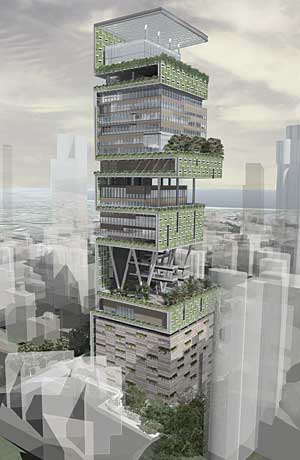
I recently learned about the Antilia building, which is under construction in Mumbai, by Perkins + Will, for Indian tycoon Mukesh Ambani. A couple of descriptive paragraphs:
Construction is underway, albeit with some delays, on one of India’s highest profile and most opulent projects—the Antilia, a 490-foot-tall corporate meeting facility and private residence in Mumbai. Chicago-based Perkins + Will designed the 24-story tower for business tycoon Mukesh Ambani, whose family will occupy roughly 35,000 square feet in its top floors.

Among its interesting elements, Antilia will feature a band of vertical and horizontal gardens that demarcates the tower’s different program elements. A garden level will separate the ground-floor parking and conference center from residential space above, for instance, and the outer walls on certain levels will be sheltered by trellises supporting panels that contain hydroponically grown plants.

In addition to signaling different space uses and providing privacy, these “vertical gardens” will help shade the building and reduce the urban heat island effect. “You can use the whole wall almost like a tree and increase the green area of the site by five or 10 times over what it would be if you just did a green roof,” Johnson observers. “It’s a prototype for buildings of the future.”

Oh, wow. What a crazy building, and while some of the architectural and green design aspects are interesting, it is difficult to see how this building either fits in with the development needs of Mumbai, in general, or a commitment to green design. I guess the rich get what they want, although if this building is a prototype for the future, it seems we're moving ever-closer to a Blader Runner-like dystopia, where the rich live comfortable lives in high-rises towering above the city floor, while discharging a disproportionate amount of waste to and depleting resources from those stuck on the ground, in the shadows below.

The Slate.com article which brought this building to my attention is interesting, as well, in dissecting how efforts to create standards for certifying green building design (specifically, the LEED certification standards) can be counter-productive for really achieving green design objectives. The main criticisms seem to be that LEED's check-list based system for evaluating building design give similar weight to disproportionate investments in green design, creating mis-aligned incentives, that the checklist oversimplifies many of the design objectives and fails to create baseline standards, and that the premium is placed on achieving efficiency and not on controlling scale.

I haven't really paid attention to the evolution of LEED in ten years, but the criticisms seem like pretty standard fare for most initiatives trying to bring standards for sustainability into commercially-driven enterprises. I don't disagree with any of Daniel Brook's analysis of LEED (to the extent that I am familiar with the standards and qualified to agree or disagree), but also it bears mention how difficult it is to create initiatives that both achieve sustainable objectives and will gain buy-in from the companies that need to be properly incentivized and to implement designs and programs according to those standards. Not an excuse, just highlighting the ongoing design challenge that people serious about sustainability will continue to face.

Sunday, December 9, 2007

The Story of Stuff


First, a bit of a goof on globalism that we pulled together back in the old SPR days. While our low-fi comedic ramblings may or may not be that funny, I am still constantly shocked at how much cheap, disposable stuff you can buy in New York, and how the economics of extraction, production, labor, and transport can scale to make a $3 umbrella a viable product.

With that silly context setting, I'd urge you to check out this animated movie "The Story of Stuff," which Professor ND forwarded to me. Annie Leonard touches on a number of powerful themes, that I think are constantly missed in public dialog about sustainability, civic responsibility, and the power that people have, as consumers, in influencing their world. Specifically, I think that while a lot of people feel trapped and fed-up with our consumerist culture -- the need to buy, the lack of durability of products, a keeping up with the Joneses mentality -- and I think Leonard does a good job articulating that, while you may feel trapped, there is a legitimate choice you can make, to opt out of the cycle of consumerism. Secondly, it is important to frame the materials economy as a cycle, recognizing that the choices that are made - by consumers, by politicians, by business people - all have impacts both upstream and downstream in the cycle. Positive choices can be amplified to be even more positive, and unfortunately, the same holds true for choices with negative consequences.

While I am not always enamored by the slight shrillness of people who are active advocates in the sustainability movement, and some of that occasionally bubbles to the surface in this video, I think, in general, The Story of Stuff is a very thoughtful and engaging overview of our consumer-driven materialist culture, and should be broadly forwarded, to people who care about these issues, and probably more importantly, to people who may not know to care about them.

Additional resources worth checking out:

Free Range Studios - the design firm responsible for the production of The Story of Stuff, who apparently have a very cool charter.
The Center for the New American Dream - I haven't kept close tabs on this non-profit, but when I was paying more attention five or six years ago, they were doing a great job communicating how the objectives of adopting a more sustainable lifestyle were very much aligned with quality of life aspirations that are core to the classic "American Dream"
The Global Footprint Network - Another non-profit that focuses on trying to raise the public and political awareness of how the material flows in our economy, driven by consumerism, impact global sustainability.

Sunday, November 4, 2007

Biking as Business


An article in today's New York Times, along with an accompanying video story, discuss efforts made by the city of Portland, OR, in supporting both bike culture and local businesses. Notable as a small example of how a combination of individuals embracing a change in behavior (from cars to bicycles), combined with civic support can help move a community towards more sustainable ways of living. The scale of change and overall consequence may not yet be huge, but building a city that supports bicycle culture is one of those changes that manages to neatly entwine a positive environmental impact, a clear improvement in quality of life in embracing a change in behavior, and a very tangible example to those people who are further back on the adoption curve that embracing sustainable behavior can be both the right thing to do and the pleasurable thing to do.

A couple of side comments that struck me while watching the video:

- It is interesting that while some American cities are slowly embracing bike culture (Portland, San Francisco), urban centers in developing countries that were built around bicycle and pedestrian traffic are shifting away from those modes of transportation (due largely to increased income of the middle class and status-driven changes in behavior).
- Is it a necessary condition of cities moving towards sustainability in the U.S. that they be populated by goofy white people? An un-serious phrasing of a serious question: how does the culture of sustainability become appealing to minorities, people in the inner cities, people with more conservative/traditional visions of success and status, new immigrants?
- Can anyone recommend me a good model of bike to buy, for casual city use? I'm looking for low maintenance, sturdy, relatively light-weight, and built right for my somewhat shorter (5'6") frame.

Photos from a Flickr search for 'bicycle.' Actually, quite worth a look-see.


Sunday, October 28, 2007

Supply and Demand: Energy and Food Policy

A few weeks ago, I went to a lecture arranged by the Stanford alumni association by Professors Roz Naylor and David Victor at NYU. Professor Naylor, who I studied with briefly, is an economist who has long focused on food economics and other issues inter-relating environmental and developmental policy, and Professor Victor, whom I did not cross paths with at Stanford, is a law professor focused on energy policy. The lecture was good, although brief and, as such, handled some very complex issues very simply. A few modest comments that have been kicking around in the back of my head for the past few weeks:

- Professor Victor made an interesting comment in response to a question about whether small-scale "clean energy" solutions constitute an effective energy policy. Specifically, the question seemed tied to a lot of success stories coming out of India and China where distributed energy producers (like local solar-powered batteries are loaned out at the village-level) are emerging to meet the burgeoning energy demand that is occurring in areas not well served by existing energy grids. The substance of Professor Victor's comments was that while such trends were interesting, distributed/point solutions to supplying energy would simply never scale -- and therefore, couldn't be a central part of a sustainable energy policy. He suggested, as I understood, focusing on large capacity production that could be made "cleaner," including nuclear, natural gas, and the cleaner forms of coal burning. While I agree that the magnitude of our energy problems require large scale solutions, I am always curious at how quickly distributed solutions are dismissed as being a component of an overall policy solution. Unfortunately, the session was too abbreviated to really push the issue.

- Professor Naylor forced me to an interesting, if unintended, connection between food policy and energy policy. I'm still sorting the thinking out on this, but it basically works like this:

1. We are confronting a supply problem in the world energy markets. The increasing demand for energy, driven by growing economies and growing populations, can not be met by our current, known energy production capacities. We need to innovate on the ability of the world economy to deliver energy (and when you tie in climate policy, clean energy) to the marketplace.

2. In the 1940s and 1950s, the world confronted a supply problem in food markets. Population growth created greater demand for food than was immediately available. Investments were made in food technology, specifically fostering the Green Revolution. The Green Revolution was successful in increasing world food supply, which, in turn, certainly staved off a lot of human destitution. However, simply addressing the supply problem did not address the challenge of world hunger. Massive logistical problems, failure of political will and infrastructure (notably, corrupt/incompetent third-world governments failing to deliver on food aid provided by incompetent/corrupt multinational aid and relief agencies, including UN and GATT), failures in wealth distribution to the poorest segments of economies, and disproportionate population growth at the bottom of the demographic pyramids (from both an income and a poverty level) thwarted a purely supply-side solution to the food problem.

So, the question I have, with this history of food policy behind us, is why do we continue to think of the energy problem as strictly a supply issue?

Not that I have a pat answer to this question, but the inability of the political, economic, and academic leaders to address either the demand side of the equation or the equality issues bound up in how resources get consumed fails to take our analyses of these problems off charts and graphs and into the human dimensions of the real world.

Still, a very compelling talk, with a lot of interesting issues to follow up on.

Monday, October 8, 2007

Green Monsters

Flipping through a magazine the other evening, I stopped on a two page advertising spread by Chevron entitled "Chevron Presents: Energyville." Billed as an "energy game," Chevron asks "This is your city. How will you power it? How do we meet growing global demand? What new kinds of fuels and power sources should we develop? And how do we safeguard the environment at the same time?" The reader is then directed to play the game, hosted at the website www.willyoujoin.com.

Now, it is easy to be dismissive of the efforts of massive energy companies to engage in fundamentally changing the dynamics of our energy economy. Their generally upbeat and eco-friendly advertising campaigns, which cheerily suggest that we've got a problem, but, hey, together we can fix it are a little to, well, cheery and upbeat. And I have no illusions that the extremely rich and extremely powerful people who run these companies are concerned as much about tackling global sustainability problems as they are about finding new markets in which to create better margins (after all, when they send the lucky one percent into space after we've despoiled this lovely planet, no doubt the heads of oil companies and their antecedents will be first in line at the launching pad).

But it can't be denied that each and every energy company, whether on the exploration/ production-side or the delivery-side, has a distinct strategic interest in understanding the dynamics of energy in coming years, influencing the market to align with the investments in technology that they are making, and innovating more efficient (and, consequently more eco-friendly, one would hope) solutions to our collective energy needs. Nor can it be denied that the actors most readily positioned to dramatically influence our energy economies are the energy companies themselves. And outside a small coterie of academics and advocacy groups, no one has been forced to think quite so deeply as the energy companies.

Which all sounds like a resounding defense of the Goliaths! Not meant to be. But what has caught my interest is the effort made, in advertising and public relations, at least, by energy companies to engage the public in a dialogue about our energy future. And with the resources available to them, energy companies have been able to provide slicker tools to help the conversation move forward, and often are doing quite a good job at putting out worthwhile information and analyses. Take the aforementioned game at www.willyoujoinus.com, BP's Carbon Footprint Calculator or Statistical Review of World Energy site, or ConEd's more humble, but useful campaign to educate consumers on household energy conservation tips.

Are my fundamental concerns about energy consumption allayed? No. Do I think that these resources are actually useful in furthering questions about looming energy problems into our consumer consciousness? Yes.

Wednesday, September 26, 2007

Not Enough? Doerr on Green Tech


KPCB is a remarkable organization. They have been incredibly effective at identifying, investing in, and cultivating truly revolutionary ideas over the past 30 years. I have worked within the KPCB family, at a low enough level not to be noticed conspicuously, but at a high enough level to have some visibility into how Kleiner does things. Fundamentally, the ability of KPCB to marshal talent to create markets and solve problems through innovation in technologies and services has been impressive. And in the past few years, Kleiner's increasing attention on "green tech" and questions of long term environmental sustainability has been a positive development - even if a $200M net investment is, to steal John Doerr's reprise, "not enough." Not that I'm really knocking the investment and, heck yes, I'd love to be involved in another Kleiner company tackling green tech problems..

So I was very curious to hear what Mr. Doerr, the talisman of Kleiner's success in the last fifteen years, had to say about green technology and our looming environmental problems. Mostly, I'd suggest that you watch the video, as I think it speaks for itself - and the message is clear: while many actors, from Wal-mart in reducing its energy footprint to Brazil shifting to biofuels, have been able to successfully innovate to mitigate their environmental impact, the scale of change is simply not big enough yet. And I whole-heartedly agree with that basic analysis.

Beyond that, I do have some comments:

- Doerr identifies four agents of change ("four lessons") that can be influenced by entrepreneurs: Companies, Individuals (i.e., Consumers), Policies, and Radical Innovation. While I agree with his implicit commentary, that the efforts of any given influential individual (i.e., TED audience member) might be best targeted at a company, a government policy, or invested in innovation, and not targeted at changing consumer behavior, I think that Doerr, and most of the policy makers, innovators, technocrats, and academics give short shrift for the need to change the behaviors of individuals, and the need to address individuals directly through politics and cultural dialogue. I'll come back to this;

- Doerr frames the market opportunity of addressing the world's energy crisis as a $6 trillion dollar market. I agree. This market is huge. I also firmly believe that market forces, and disruptive innovation to meet market needs can radically change both the supply side economics of meeting a market need and the demand side behaviors in creating that need. What I do find curious, however, is framing the energy market as the market that needs to be satisfied to address the world's sustainability crisis (or put another way, isn't sustainability a much bigger question than a looming energy crisis)? Isn't energy always an input to other goods and services? Like transportation, primary industrial processes, commercial and residential electricity, etc. Don't we need to start thinking about how to fundamentally change the dynamics of those markets, not just focus on how to more efficiently solve the energy supply question?

- Selling a vision is a key part of what any entrepreneur must do, particularly entrepreneurs trying to market disruptive technologies. Do we have a coherent vision of what a sustainable future might look like? What kind of house will I live in? What kind of car will I drive? What will the place that I live in look like? I think some of the symbolic examples that are drawn forth in the current conversation on green tech are useful in selling this vision: electric vehicles, biofuels, carbon markets. But do we have a coherent vision of what a sustainable future might look like? And are we effectively communicating that vision?

- At the end of his speech, Doerr urges his audience with a few calls to actions, exhorting them to "really think outside the box." His suggestions are all good: make going green "your gig," get carbon neutral (and buy carbon credits), join other leaders in lobbying for cap-and-trade systems for greenhouse gases, use your personal power or rolodex to "go green."

But what about the potentially most seismic change: consume less?

Why is this meme never engaged by the business, political, and academic leaders who claim to be serious thinkers about the environment?

Personally, I don't think it is either a naive conversation to engage, nor one that necessarily a compromise in quality of life or achievement. There are abundant reasons to believe that a less materially-driven life and culture will not only improve our ability to change market dynamics and address the salvo of "not enough," but will actually improve our quality of life, as well. But if our business and political leaders refuse to engage in this conversation, then the core dynamic driving the demand side of our market equations, and the A in our good old IPAT formulation, that dynamic will never change.

Monday, September 17, 2007

NYC - Green Master Plan

I was not in New York this past Earth Day, so I guess I missed the detailed news about New York City's "Green Master Plan," as advocated by Mayor Bloomberg this past April. I have nothing but grudging respect for what Mr. Bloomberg has been able to accomplish in the city, and am intrigued by the scope of his plan, as well as some of the messaging being used to promote it (although I don't know how visible it actually is...)

I haven't read enough yet to have an opinion, but for more information, check out this official site.

Friday, September 14, 2007

Sustaining Junk


In college, I studied economics and environmental science and policy. The two disciplines are very rarely harmonized, and people who think seriously about sustainability from an ecological perspective have been able to challenge a lot of assumptions core to economic modeling. When we consider the global ecological system, we are forced to account for behaviors, constraints, and outcomes that are generally ruled out-of-bounds for the purpose of economic decision making - for example, performing cost-benefit calculations and making rational choices where the consequence must be spread over long time horizons, recognizing and valuing all externalities in a system, creating an accounting system for resources, like air and water, than aren't traditionally paid for with money, but which are fundamental to all economic transactions, understanding scarcity in situations like extinction, and so on.

For all the challenges that environmental thinking can pose to economics, a key vexing question that economics posed to ecological systems was the ability of the market, through demand, competitive advantage, and ultimately price, to foster technology innovations that would, at the right time and over time, allow us to address environmental problems through technological solutions. A key example of this has always been in energy, where one line of thinking projects that, as soon as the market conditions exist that make innovation in alternative energy feasible, that market need will be filled. And perhaps we are seeing the beginnings of such a set of innovations in green energy today.

A recent Slate.com article got me thinking again about this issue:
In an act of macroeconomic karma, materials thrown out by Americans—broken-down auto bodies, old screws and nails, paper—accounted for $6.7 billion in exports to China in 2006, second only to aerospace products. Junkyards may conjure up images of Fred Sanford's ratty collection of castoffs. But these days, scrap dealers are part of a $65 billion industry that employs 50,000 people, who together constitute a significant arc of a virtuous circle. The demand of China's factory bosses for junk—which they recycle to make all the junk Americans buy from China—creates jobs, tamps down the growth of the trade deficit, and might help save the planet.
Is it possible that one nation's folly in managing resources can be another nation's opportunity, and that on a global scale, the market will be efficient in distributing resources (and managing the impact on those natural resources need to sustain economies and fuel innovation?) It seems folly to blindly say yes, although I believe many business decision makers believe this to be true, if not in this exact framing, then as evidenced by the way they behave.

Where this strikes me as folly is that it fails to create the right incentives, culture, or organization (switching from economics to business) to address more efficient use of resources. It puts us in the wishful position of hoping that the market will create conditions to clean up its mess, rather than avoiding the mess in the first place. Put another way, it puts the burden of sustainability on policy makers, influencing the outcomes of a business system, rather then as a design challenge, influencing the initial objectives and processes of the system.

It is as a design challenge that sustainability becomes a truly influential idea for business and the economy, and while I'd like to return in further detail to this topic, I will leave off by highly recommending you watch the Bill McDonough video hosted on the TED site, above, as well as reading a bit about McDonough's Cradle 2 Cradle design philosophy - which can be consumed as a very interesting book (in both the intellectual and physical sense, the book itself having been designed according to the Cradle 2 Cradle principles), as well as on many websites, including McDonough's own website.

Friday, August 24, 2007

Adorable Do-Gooders

I cannot say enough good things about MF and JJF's incredible project, Kiva.org. And the good press just keeps rolling in. Check out the adorable video on Yahoo.

Tuesday, July 24, 2007

Get Green: Design Leads the Way

In my mind, there are three keys to solving the "green equation" of how we can live more sustainably, particularly with respect to energy and natural resource consumption. The first is driven by science and public policy, and has to do with our ability to discover and develop fundamental advances in our ability (as a society/economy) to get the goods and services we need out of the primary inputs we consume, with minimal adverse impact. Clearly, research and development efforts in fields as disparate as biofuels, solar/fuel cells, genetic engineering, carbon sequestration and other core science and technology initiatives are targeting these fronts. To my inexpert eye, the investments we are making here are limited to-date, and the initiatives, though encouraging, are insufficient.

The second piece of the puzzle is cultural, and lies with the willingness of individuals, as consumers and political actors, to make decisions that take into consideration environmental consequences. These decisions include choosing to consume less, pay market premiums for goods and services that provide greater dividends in protecting environmental and natural resources, and promote, through voting and civic engagement, a political climate that supports policies targeting sustainable development. A political and economic climate created by an environmentally conscious public could more effectively create market opportunities for alternative, efficient technologies, fund research in core sciences and technology, re-aligning tax policy to create incentives environmentally responsible behavior, and create a baseline understanding of the values and ethics of "sustainable development." While the cultural sensitivity to certain issues like global warming and a potential energy crisis have been heightened in recent years, I don't think that a true ethic of sustainability is anywhere near close to existing in the U.S. Additionally, as a sometimes student of economics, I'd mention that much 0f what I discuss above is somewhat anathema to parts of economic theory - in that, I believe that people as consumers will have to make economic choices that aren't rational w.r.t. price because of a deeper core set of values, ethics, or understanding about environmental consequences. Consumers will have to shape the market, not vice versa.

The third piece of the puzzle is very much design-driven, and have to do with the ability of architects, engineers, product designers, and policy makers to create appealing consumer choices - in terms of what car to drive, where to live, what to buy, and so on - that align environmentally-positive consequences with benefits that appeal to other values, like status, cost efficiency, comfort, quality of life, aesthetics, and so on. Where I have a dim view of the progress we're making on each of the previous two fronts, I am excited about the cool new products, across all facets of life, that seem to come out every day. While the impact on the bottom line may be modest, it is tangible. And the further impact of these "green" products and policies, if successful may be a heightened environmental consciousness for individuals and greater investment from government and private capital in the fundamental technologies that can allow us to take big steps forward.

I lay out this somewhat abstract framework for two reasons: first, simply to put it out there, to solicit feedback, and to reference in future posts. I hope it is a useful framework. Second, as an excuse to post about a handful of interesting innovations in technology and design recently published in Wired magazine:

- A proposed new dorm at Stanford University, whose theme will be eco-efficiency, but which also proposes to be the "most desirable housing on campus." Thankfully, having gone through Stanford's undergraduate housing lottery, that claim is readily falsifiable. See here for more detailed plans;
- A Jetsonian plan for improving transportation efficiency and quality of life in San Diego, through the deployment of "robot buses." Cool if it works, and a great example of how environmental efficiencies and quality of life improvements can be made in one fell swoop;
- A proposed residential tower in Chicago that falls back on pre-Columbian building design to create a more energy efficient and more pleasant living environment. The simple decision to angle the buildings Southern exposure to maximize passive solar heating in the winter, and minimize direct sunlight in the summer helps keep electricity and heating costs down while letting more natural light in. Not the first time such a dwelling was built in the Americas, and hopefully not the last.

Tuesday, June 19, 2007

Green Ambition

On my jaunt out to San Diego last week, I picked up a copy of Seed Magazine, which takes stylistic cues from Wired and other culture magazines, and applies them to the world of science, producing a sort of hipster-Scientific American, I guess. I've read the magazine a few times, and have generally found it to be decent. In the June 2007 issue, I was specifically drawn to the cover story, "The China Experiment," promising a detailed look into technology initiatives native to China focused on improving the environment. While the article contained a couple of interesting facts (15 of the top 20 cities on the World Bank's assessment of "most polluted cities" are in China), a number of quoted platitudes ("It's historic," says Kishan Khoday, head of the UNDP's energy and environment program in China. "It's going to take efforts on all angles of the issue to get it done"), by and far the most interesting parts were the anecdotes of specific initiatives that have been undertaken to green China, sometimes in unique ways. For example:
"For the Olympics, a designated weather modifciation office will reduce air and ground pollution before the Games by shooting rockets filled with silver iodide into the sky to make rain. Beijing's Science and Technology Department has been experimenting with hormone therapy and cross-breeding to produce flowers that can withstand a Beiging August. "I'm sure that during those three weeks it will be crystal-clear in Beijing," energy analyst [Jim] Brock says. "They're playing with all sorts of things."
A weather machine? It's the sheer audacity of the project that is both terrifying and encouraging. Perhaps when they focus their energy on climate change or clean energy production. On a less sinister note, the article also mentions the growth of market for locally-implemented solar power solutions - where in villages and small cities with inconsistent grids, local entrepreneurs have seized a market opportunity to create stores like the "Solar Supermarket" dealing in solar generators, heaters, and cookers that provide cleaner energy to poorer populations.

On a separate note, CNN.com carried a story today about Google.org announcing an initiative to develop plug-in hybrid electric vehicles that would far out-pace current standards for mgp. While it seems doubtful that even $10 million is sufficient to make a dent in the problem, Google's commitment to innovation in new problem spaces continues to impress. More over, the dual focus on technology innovation and thinking about new ways of addressing the market are also very encouraging:
Google said Tuesday it is getting in on the development of electric vehicles, awarding $1 million in grants and inviting applicants to bid for another $10 million in funding to develop plug-in hybrid electric vehicles capable of getting 70 to 100 miles per gallon.

The project, called the RechargeIT initiative and run from Google's philanthropic arm, Google.org, aims to further the development of plug-in hybrid electric vehicles - cars or trucks that have both a gasoline engine and advanced batteries that recharge by plugging into the nation's electric grid.

"Since most Americans drive less than 35 miles per day, you easily could drive mostly on electricity with the gas tank as a safety net," Dan Reicher, director of Climate and Energy Initiatives for Google.org, wrote on the organization's Web site. "In preliminary results from our test fleet, on average the plug-in hybrid gas mileage was 30-plus mpg higher than that of the regular hybrids."

The project also aims to develop vehicle-to-grid (V2G) technology, allowing cars to sell their stored power back to the nation's electricity grid during times of peak demand.

Monday, June 18, 2007

Is City Living Too Dear?

RM sends an article describing a project by the organization Best Foot Forward to systematically measure the Ecological Footprint of the city of London. The article, which is part of a sequence of articles on "Megacities," posits that city dwellers contribute a disproportionate load to energy and resource consumption, and that the growing move to urbanization, generally, and "Megacities," specifically, represent an increased ecological concern

Urbanites, even in poor cities, tend to have the money to consume more than their rural brethren, Rees says, so cities tend to have outsized ecological footprints. However, he notes, public transportation, efficient heating, streamlined services, and other things that are economical in cities but not elsewhere can ease urbanization's impact on the environment. “Cities do enable—if we organize them properly—the displacement of private cars in favor of public transportation, cogeneration, recycling, and remanufacturing,” he says. “In general, high-income cities increase the ecological footprint because of rising incomes and rising consumption, but we could—through intervention in the economy, appropriate planning, densification, and tax policies—turn it around. But so far we are choosing not to do so.

”The number of urbanites has tripled since the early 1960s and now represents half of the world's 6.5 billion population, which approximately doubled during that time. Meanwhile, our global footprint has more than doubled since the early 1960s, when it took up half the planet's renewable resources. It now exceeds the Earth's resources by about 25 percent, meaning that we are degrading the planet's ability to support us. If you think of those resources as a bank account, we are no longer living only off the interest. We are spending capital.

In sending the article, RM mentioned that he was surprised at the assertion that urbanites were bad ecological citizens, citing his impression (one that I share) that cities tend to be more efficient consumers of resources, due to economies of scale, generally, and the enabling of specific public policies, like those mentioned in the article, for which cities allow.

So how to disentangle the assertion of urbanites as bad actors? Well, the first is to understand the comparison. When comparing the Environmental Footprint of an urbanite to a ruralite, I think the assertion probably holds true. Let's consider a developed economy comparison of an urbanite in a city like New York or London to their rural counterpart - it is probably true that the urbanite both consumes net more products and services as well as requires those products and services to be imported in to the city and disposed of out of the city, whereas the ruralite may consume more locally produced products, and be able to dispose of them more efficiently (if not, necessarily, any more safely). Similarly, in a developing country standpoint, the challenge often may be that those ruralites are, in fact, rural poor, and simply do not have the economic capability to consume at parity with their urban counterparts, even the urban poor. In both cases, the impact is likely to bias the comparison against the urban population.

The challenge in that comparison lies in the fact that, at least as far as modern economies have grown, people get drawn to urban centers based on the ability of cities to create wealth, jobs, and opportunity. The logical conclusion of a finding that rural living is more sustainable that urban living - which would be to encourage more people to live in rural settings - does not hold at scale, because rural economies generally can't sustain the population mass, and therefore, those populations migrate to urban centers. Hence, global trends towards urbanization.

I think the more salient and actionable lessons from the analysis are to focus on patterns of consumption (among both rural and urban populations, but probably exaggerated among urban populations), trying to align consumption more closely with sustainability (i.e., how can we convince people to simply consume less) and separately, investing in public policy that continues to increase the efficiency by which products and services can be delivered to urban markets.

And a last note - the greater difficulty in the urban vs. rural comparison above is that it is probably not the demographically relevant comparison. Rather, of a greater concern is the trend to suburbs, exurbs, and other types of "cities" where citizens have the "richer" consumption patterns of urban environments, but benefit from none of efficiencies in delivering those services created by dense, urban environments. This rapid development of suburbia, and the patterns of living and consumption there are the demographic trend probably warrants the most concern.

Monday, May 7, 2007

It Ain't Easy Being Green

My Indulgent Lifestyle
The world is going to shit, and I'm part of the problem. There's no doubt about it. I'd like to think I'm part of the solution, but it's just not realistic. Consider: If everybody in the world lived a lifestyle like I do (small, walk-up apartment in New York, no car, subway to work everyday, modest consumption of convenience goods), it would take over 6 planets to sustain our resource needs.

This assessment courtesy of the Ecological Footprint assessment quiz, available from MyFootprint.org. The quiz, which takes less than 10 minutes to complete, helps evaluate what the environmental impact of your lifestyle and consumption habits, captured by the Ecological Footprint indicator. If you've got a second, take the quiz, and then come back and read on.

A Little About the Ecological Footprint
Ecological Footprinting is a methodology of evaluating how big an impact each individual has on the earth (it is also useful for measuring impact for other "units" like cities, companies, and nations), in a set of simple and discrete composite indicators. Based on principles of resource accounting and material flows through systems, Ecological Footprints (EF) try to estimate the impact that each and every individual has on the global environment, specifically in terms of resource use. Initially developed by Dr. Mathis Wackernagel as a PhD thesis, and later refined at Redefining Progress and currently the Global Footprint Network, Ecological Footprints have been widely employed as a tool for helping people (students, concerned community members, business people, government leaders) better understand exactly how resource-intensive our lifestyles can be. While the EF can help you better conceptualize your environmental impact, it is even more beneficial in helping you understand how you might reduce your impact -- by making discrete (though rarely insignificant) changes in your life.

The EF is a great heuristic tool, and among other things, helps set a common standard measure to help judge whether you are doing better or worse in terms of environmental impact over time. That said, it should be noted that Ecological Footprinting is a very imprecise science, reducing and generalizing complex ecological concepts for the sake of comprehensibility. Additionally, the methodology, particularly as it is expressed in simple quizzes, cannot account for every variable in a person's impact on the environment. For example, the Ecological Footprint does a poor job accounting for the impact of persistent toxins in the environment - materials which, once entering an ecosystem, cannot be absorbed and processed by the ecosystem. Similarly, any given EF is a snapshot in time, and will not account for improvements in technology that may make it more efficient to extract resources from nature and process them into the goods or services you consume. To learn a bit more about the methodology itself, see the Global Footprint Network.

As a quick point of disclosure, I spent four months working on the first Ecological Footprinting quizzes while a research assistant at Redefining Progress in 1999.

What My Ecological Footprint Tells Me
I find the best way to take value from the EF quizzes is to first complete the quiz as faithfully as possible, and then go back to the quiz and vary your responses, in order to find out what aspects of your lifestyle have the greatest impact on your Ecological Footprint. In my case, my base EF was a whopping 29 acres -- much bigger than the half-acre lot I grew up on, with its little vegetable plot in the backyard.

So what about my lifestyle causes this impact? There are a few discernible factors:
  • I eat meat fairly regularly. Meat is an energy and resource intensive food to raise, process, and deliver to market, particularly when compared to a diet consisting of less meat and more grains and vegetables.
  • I live alone. While I don't have a particularly large apartment, living by myself does proportionally increase my share of household related impacts (electricity and water consumption, household waste) when contrasted with multi-person households.
  • I travel, by plane, a lot. For both work and pleasure, I travel. Not surprisingly, the environmental cost of air travel is quite significant (think about the equivalent fuel you might consume driving to all of the same destinations to which you fly).
What, then, is good about my lifestyle? Well, when your EF is 29, not a ton. But some positives include:
  • Commuting via mass transportation and foot. The shared energy burden that public transportation allows can greatly reduce your footprint, and, of course, biking and walking are the most efficient ways of getting from point A to point B.
  • Living in a big city. Although this isn't well captured in the MyFootprint quiz, living in urban centers can significantly reduce your environmental impact, when compared with living in the suburbs or in traditional houses not specifically retro-fitted to be environmentally friendly. In cities where residential and commercial uses are mixed, where public services are shared, and generally, efficiently distributed, individuals are able to consume a proportionally smaller share of resources.
  • Shopping smart and shopping less. Being aware and trying (although not always succeeding) to shop for products that are locally grown/made, to cut down on energy associated with transport, have minimal packaging, and generally, not buying a lot can help your impact profile.
Those modest good points aside, the average American has an Ecological Footprint of 24 acres per person, requiring 4.5 hypothetical planets to sustain this level of consumption, if we believe that everyone in the world is entitled to pursuing similar happiness. So what to do about it?

Lifestyle Choices
Already implicit, I would hope, in the EF quiz are changes that an individual can make to lower their total impact. Unfortunately, the choices are rarely as simple as "Paper versus Plastic." More often, these choices are much more core to major lifestyle decisions: where to live, what car to drive, what to eat, how big a house to own. While the choices aren't easy to make, the environmentally healthy choices are generally clear: live near where you work; walk, bike, or take public transport, if possible; buy hybrids and fuel-efficient cars instead of SUVs; eat locally grown food, with as little packaging as possible; eat meat as infrequently as possible; own a smaller house that is equipped with energy-efficient features.

Can You Be Green and Be Happy?
One of the unfortunate bugaboos of the environmental movement is that it is comprised of a bunch of dour, nay-saying party-poopers. The tendency to frame environmentally positive choices as being negative, in terms of requiring a person to make a sacrifice in the quality of their lifestyle, is another unfortunate hallmark of how people understand environmental decision-making. Many environmental choices, however, are net-positives in terms of quality of life, and should be framed as such: a diet richer in grains and vegetables will be healthier than a diet that is red meat-heavy; living closer to work means less commute time and more personal time; mixed use communities tend to be more vibrant and active than commuter suburbs.

That said, it would be naive to think that every environmentally positive decision will also make a person happy. And, of course, the lifestyle choices listed above will only work and last if they are in line with what is fulfilling to an individual in their life.

To read more about how to make personal lifestyle choices that are more green, see Slate.com's Green Challenge.

Personal Choices vs. Political Choices
Unfortunately, for most people living in the U.S., it is very difficult to live with modest environmental impact by making personal choices alone. Unless you are willing to put a good deal of effort in to making your house energy efficient, not drive much, and have good luck aligning your work life and personal life, chances are you'll end up a net-consumer of environmental resources. Certainly this will be true if you are an "average American."

What this requires, for those of us who care about the environment and sustainability, is to be active in advocating political and economic outcomes that can make it easier for everybody to be environmentally more responsible. Such political and economic choices might include promoting community development policies that focus on mixed-use communities, functional downtowns, and useful mass transit systems; supporting a locally-focused food economy and creating incentives for local business to provide good and services locally; buying and promoting alternative energies, including hybrid cars and cleaner energies from the power grid.

The list goes on, and I'll try to spend more time in later posts talking about both personal and political choices that can have a positive impact on the environment and quality of life. Of course, as someone with an EF of 29, I offer this not as preaching, but as part of my own quest to find a happy medium between choices that enrich my life and choices that are environmentally responsible.

Sunday, April 8, 2007

Good Future, Bad Future (Part 1 of Infinity)

"Among cultural intellectuals, pessimism is the style," he says with a tinge of scorn. "You're not a paid-up member unless you're gloomy." But when it comes to climate change, he finds (quoting the Italian revolutionary Gramsci) that scientists can combine "pessimism of the intellect" with "optimism of the will". "Science is an intrinsically optimistic project. You can't be curious and depressed. Curiosity is itself a sure stake in life. And science is often quite conscious of intellectual pleasure, in a way that the humanities are not."

- Ian McEwan, interview in The Independent

While The Independent was wasting my time with a long and rambling interview, the Economist was publishing its quarterly Technology Review (subscription required).

It's worth a read, if you have the March 10th copy of the magazine sitting around, and twenty minutes to kill. Two short notes. The article "Plan B for global warming" focuses on possible technological solutions to climate change that involve purposefully cooling the earth. While in the abstract, this doesn't sound bad, and then, on second thought, still in the abstract, it sounds like a disaster, it's important to consider the merits of the various proposed technologies:

For example, Dr. Paul Crutzen, a Nobel prize-winning atmospheric chemist would like to spread tiny particles in the upper atmosphere to reflect the sun's rays, not unlike the fine sulphate particles ejected by large volcanic eruptions like that of Mount Pinatubo, in 1991.

John Latham, a scientist at the National Center for Atmospheric Research in Colorado suggests blasting tiny droplets of seawater into the air to stimulate the formation of highly reflective, low-lying marine clouds. Stephen Salter of the University of Edinburgh one ups Dr. Latham, having already designed an unmanned vessel to do just that. As the Economist notes, blue skies would be less frequent, but the sunsets would be prettier.

Finally, Dr. Roger Angel, an astronomer at the University of Arizona, has suggested assembling a cloud of millions of small, reflecting spacecraft less than a meter across at the inner Lagrange point, where the spacecraft would block out 1.8% of the sun's rays.

It sounds like a good idea, but maybe we should first consult with Montgomery Burns?In other news about villains with unfair reputations, apparently in 1972 Richard Nixon insisted that if American ingenuity could transport three men 200,000 miles to the moon, it could also find a better way to transport 200,000 men three miles to work.

Amen, Mr. Nixon.

Apparently, only the University of West Virginia took up the challenge. The Morgantown Personal Rapid Transit system is, in fact, the city of the future. Here it comes. And, according to the Economist, it is coming again... Thank you Mr. Nixon, and thank you, Epcot Center.

Road trip to Morgantown, anybody?