Saturday, September 20, 2008

Come Together


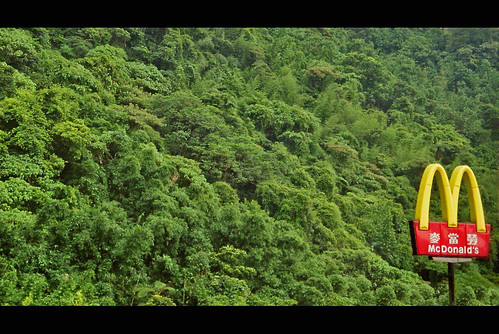
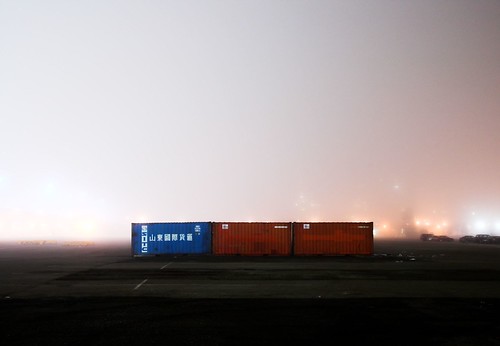
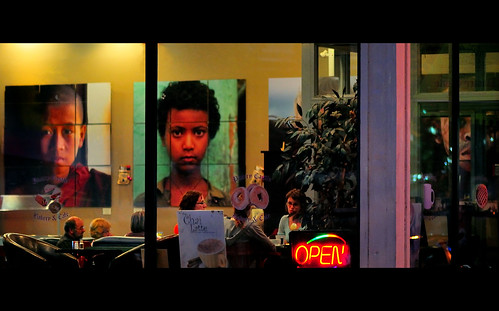
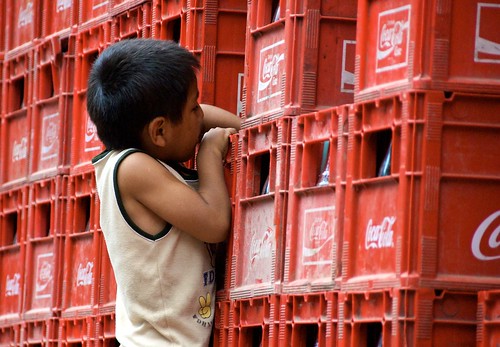
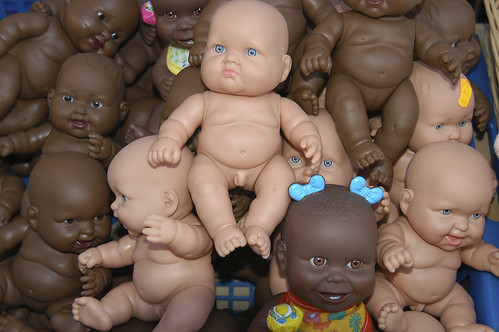
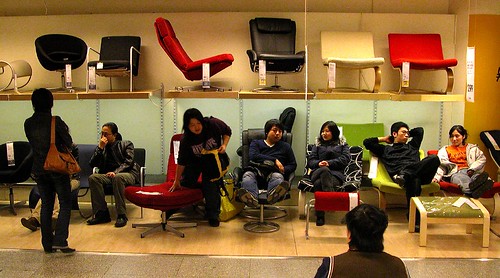
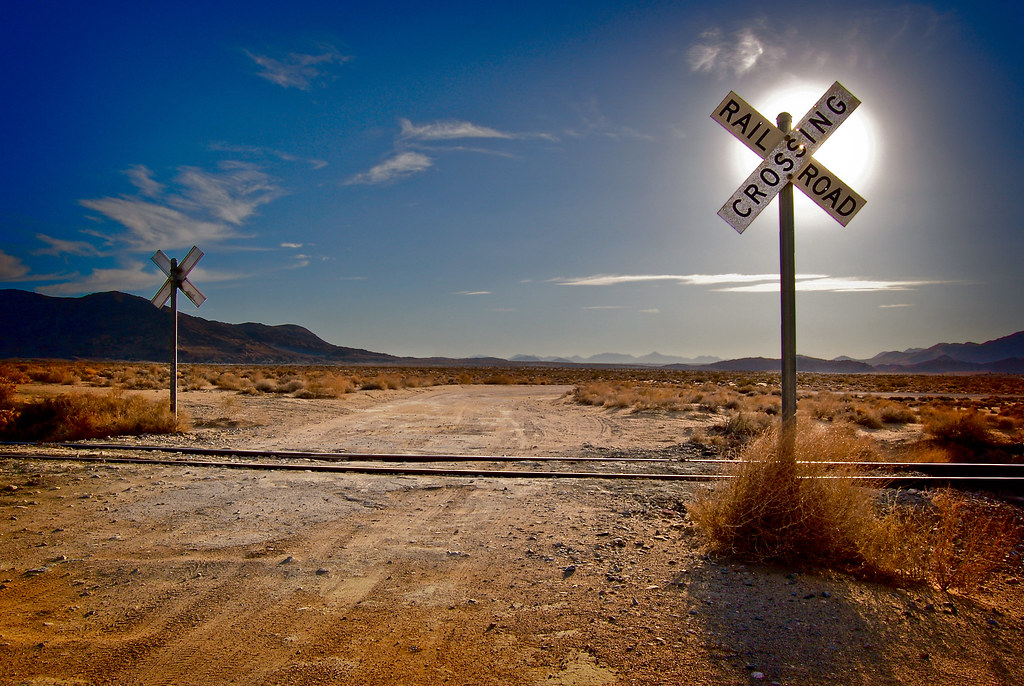
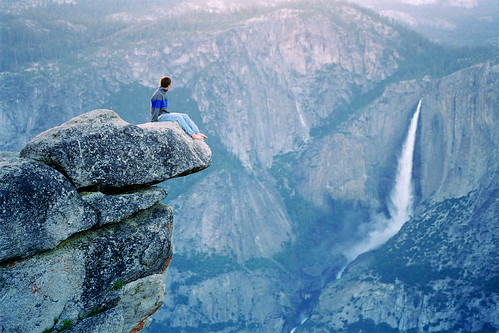
Events large and small have gotten some thoughts about globalization and its consequences, good and bad, rattling around in my head. From the crisis in the financial markets and the amount of debt and liabilities our corporations and government owe to foreign governments, to the bombing in Pakistan that headlines today's news, to some humorous but melancholy interactions with young, recent immigrant workers in stores in downtown Manhattan, to the changing demographics of New York's outer boroughs, even to this video ostensibly about violence among ghetto youth in France. Since nothing particularly coherent or insightful has yet formulated, I'll only share some photos from a Flickr search, tagged with 'globalization.'


Gates + Seinfeld

On the one hand, America can't handle 'elites.' On the other hand, this:


I tried to let the first one go, and I do like me some absurdity, but so far, this makes no sense as an advertising strategy. I have to assume that something is going to come together... Otherwise, someone's got some 'splainin to do...

BTW, in case you missed it, the first one:


Tuesday, June 24, 2008

Amount of Space...


Figure 2.6: Amount of space required to transport the same number of passengers by car, bus or bicycle. Click here for larger image.


Thursday, June 19, 2008

Sze Tsung Leong

The photography of Sze Tsung Leong is really a phenomenon document of the majesty and tragedy of our world. I wrote about it on the other blog, but feel the need to cross post. I highly recommend checking out the collection Horizons online, and recommend even more strongly seeing it in person, if you get the opportunity.

Tuesday, June 17, 2008

Sunday, June 1, 2008

Method.com

About 11 months ago, I joined Method, a brand experience firm with a strong focus on design and technology that has built an excellent reputation over the last 10 years of delivering sometimes beautiful, sometimes innovative print, web, and other interactive projects for a wide-ranging client base. As I mentioned a few posts back, Method has launched our new website:

www.method.com


Check it out, and tell us what you think!

Can The West Lead Us To A Better Place?


An interesting article from Stanford Magazine, if slightly Stanford-centric, on the demographic changes that have shaped the American West in the past 140 years from Stanford professor David M. Kennedy, whose classroom lectures I would occasionally sneak into, not being a history major. The key themes of the article, briefly summarized: since the symbolic act of completing the Union-Pacific railroad, and more strongly pronounced since the onset of World War II the American West has undergone profound growth and demographic changes that act as both a model for an increasingly heterogeneous world and fundamentally relocate the centers of influence and power within the United States. A couple of minor notes:

- Kennedy suggests the immigrant mix of the American West as a potential model for other parts of the world (Sweden, Ireland) unaccustomed to the challenges of diversity. But is the American West, with an abundance of available land and a lack of centuries-old and strong cultural traditions, really a good model for the challenges of Europe and other nations trying to integrate new populations?

- Kennedy notes that in 1960, the last time an American president was elected from somewhere other than the South and the West, California had 32 electoral votes to New York's 45. Currently, California commands 55 votes, with New York's share having diminished to 31 -- and further, states that lie west of the 100th meridian cast 200 of the necessary 270 votes to elect a president. Kennedy speculates that, should demographic patterns hold, the West as a voting bloc may be able to elect American presidents on their own. Will the 200 year old precedents in the constitution hold under such drastic demographic changes?

- The environmental scarcity, particularly of water resources, that have always shaped the economies of the West (read Marc Reisner's excellent Cadillac Desert) will continue to determine the future of the West. With the growing economic influence of California, specifically, and the West's ability to foster and embrace large-scale technological change, perhaps one of the enduring legacies of the West will be in re-shaping the way large, demanding populations are able to thrive under environmental and resource pressures -- surely an enduring global challenge.

Photos above and below from a Flickr search for 'California.' Interesting, I suppose, that California in our imagination is still about the Pacific and mountains and expansive, magical vistas, and not the strip malls and subdivisions populated by the small shops owned by the Vietnamese and the Indians and the Mexicans and the huge, box-store malls where all the money goes. Or, as Thomas Pynchon envisioned it:
San Narciso lay further south, near L.A. Like many named places in California it was less an identifiable city than a grouping of concepts: census tracts, special purpose bond-issue districts, shopping nuclei, all overlaid with access roads to its own freeway. But it had been Pierce's domicile, and headquarters: the place he'd begun his land speculating in ten years ago, and so put down the plinth course of capital on which everything afterward had been built, however rickety or grotesque, toward the sky; and that, she supposed, would set the spot apart, give it an aura. But if there was any vital difference between it and the rest of Southern California, it was invisible on first glance. She drove into San Narciso on a Sunday, in a rented Impala. Nothing was happening. She looked down a slope, needing to squint for the sunlight, onto a vast sprawl of houses which had grown up all together, like a well-tended crop, from the dull brown earth; and she thought of the time she'd opened a transistor radio to replace a battery and seen her first printed circuit. The ordered swirl of houses and streets, from this high angle, sprang at her now with the same unexpected, astonishing clarity as the circuit card had. Though she knew even less about radios than about Southern Californians, there were to both outward patterns a hieroglyphic sense of concealed meaning, of an intent to communicate. There'd seemed no limit to what the printed circuit could have told her (if she had tried to find out); so in her first minute of San Narciso, a revelation also trembled just past the threshold of her understanding. Smog hung all round the horizon, the sun on the bright beige countryside was painful; she and the Chevy seemed parked at the centre of an odd, religious instant. As if, on some other frequency, or out of the eye of some whirlwind rotating too slow for her heated skin even to feel the centrifugal coolness of, words were being spoken. She suspected that much.


Tuesday, April 22, 2008

Design and the Elastic Mind

NOTE: In a few days, I'll announce the launch of our new www.method.com website. As part of the modern condition (and an up-to-date approach to extending our brand), we've got a corporate blog. Some of my thinking will be shifted there. I'll try to cross-post when appropriate. The following post is appropriate.

On Saturday, I took a trip up to the Museum of Modern Art in New York. The purpose of my visit was primarily to see the "Colour Chart" exhibit, although I also went with every intention of spending a good bit of time in the "Design and the Elastic Mind Exhibit." Both exhibits were entirely worthwhile, so if you are in New York before May 12th, check them out. But what was remarkable, particularly in comparison to the extremely accessible Color Chart exhibit, was how complete the enthrallment of the capacity crowd streaming through the Design exhibit.

After taking an hour to wander through the exhibit, I took another 45 minutes to simply people watch, to observe how the Saturday afternoon tourist crowd engaged with the various pieces in the show. It was an amazing spectacle, as young and old, bearded and bespectacled, distinctly European and distinctly New Jersey-an were all poring over the tiny and numerous explanations of each installation, leaning over exhibit tables and pressing their faces up against cases to get closer looks at objects, and touching things that they were instructed clearly not to touch. Why? Not because the design objects were immediately and obviously cool. Many of them, in fact, were not obviously cool. They were not shiny metal things, but rather, took a bit of study and consideration to appreciate the value of the object itself..

What quickly became clear was that so much of the crowd was completely taken by the explanations of the design objects -- engaged with the thinking and leaps of imagination that informed the design, as documented in the attached descriptions, or as intuited by the curious museum-goers. As much as the objects themselves, people found delight in unraveling or having explained the smarts that went into making them. The product of design wasn't the only cool thing. Design was the cool thing, too.

So what? Well, working in a design firm, I think that one of the unique challenges we face is to find ways to engage the audiences of our design more deeply in our process. For both the consumers of the experiences we build and for our clients, part of the value that we can add (and part of the delight that we can stimulate) is by helping our audiences appreciate the thinking behind our design. This may be by actually including them in our process, or it might be by designing products and experiences that, in addition to being elegant and valuable, are themselves articulate about the analysis or inspiration or intuition from which they sprung.

Rational Choice: Carrotmob

Two fundamental concepts of economics that have always frustrated me are the following:

1. An economic choice is fundamentally a value decision made by an individual. An economic actor is making an observable choice, revealing their values and preferences.

2. A market (or the market) uses price as a mechanism to efficiently allocate resources, based on supply and demand, fundamentally driven by the sum of the collective individual preferences of each of the actors in the market.

That may be an oversimplification, and it has been a while since I've taken an economics class, but the gist is right.

So, what's vexing? Well, two things. First, while so many of us claim to believe in one set of things (say, environmental responsibility, or justice, or equality) our revealed preferences show a clear priority in valuing a different set of things (say, comfort, or convenience, or entertainment).

Secondly, while we may truly believe in one set of things, we generally do not feel that our economic choices actually can influence the behaviors of "the market." While we are all supposed to be economic agents, who's behavior, in sum, matters, we feel a complete lack of agency, as far as our ability to make choices that will actually change markets.


With these two points running around the back of my head, I comment Carrotmob, both as an ingenious embodiment of these core economic principles, and as a very cool and innovative approach of connecting the individual economic choices that we might make with real world impact. While my understanding is that Carrotmob is just getting off the ground, I fully recommend taking a look at the organization, which has the potential to be a powerful and exciting change agent, and has, at its core, a possibly sustaining business model (probably not making anybody a millionaire, but perhaps sustaining the platform for change that Carrotmob may grow into...)

Thoughts?

Sunday, April 20, 2008

GreenYour.com

I haven't had a chance to read the remainder of the NYT's green-focused magazine, but I expect I may have more to say or share from that. One of the constant challenges in trying to be more green is knowing exactly what to do. There are a wealth of great resources out there and it seems one more has been added to the mix. I haven't yet spent much time on the site, but GreenYour.com is a personal reference service for making environmentally sound choices. I believe the service was started by some folks that I crossed-paths with a few jobs back, and I figure it's Web 2.0-take (judging by the look of it) on going green is at least worth a look. More on it later, most likely.

Why Bother?

Michael Pollan with a wonderful essay in the New York Times arguing for the importance of personal choice in making a difference in the face of climate change (and an argument that can easily be extended to a wealth of other environmental, social, and economic factors). Pollan's essay touches on issues that have long troubled me. Among the positives are framing environmental responsibility as a fundamentally moral choice (albeit, in the positive sense of moral, not the finger-wagging, school-marmish sense) and framing environmentally responsible acts as pleasurable (for me, living in a city, for Pollan, planting a garden and growing your own food). More vexing is how to convince people to embrace personal change when confronted with the overwhelming sense that the problem is too large to impact, or when faced with concerns of developed countries somehow falling behind in a consumer arms race with their counterparts in China (the traditional bogeyman) or elsewhere. And kudos to Pollan for re-raising the profile of Wendell Berry, an essayist who deserves a much wider following. Read on:
For us to wait for legislation or technology to solve the problem of how we’re living our lives suggests we’re not really serious about changing — something our politicians cannot fail to notice. They will not move until we do. Indeed, to look to leaders and experts, to laws and money and grand schemes, to save us from our predicament represents precisely the sort of thinking — passive, delegated, dependent for solutions on specialists — that helped get us into this mess in the first place. It’s hard to believe that the same sort of thinking could now get us out of it.

Thirty years ago, Wendell Berry, the Kentucky farmer and writer, put forward a blunt analysis of precisely this mentality. He argued that the environmental crisis of the 1970s — an era innocent of climate change; what we would give to have back that environmental crisis! — was at its heart a crisis of character and would have to be addressed first at that level: at home, as it were. He was impatient with people who wrote checks to environmental organizations while thoughtlessly squandering fossil fuel in their everyday lives — the 1970s equivalent of people buying carbon offsets to atone for their Tahoes and Durangos. Nothing was likely to change until we healed the “split between what we think and what we do.” For Berry, the “why bother” question came down to a moral imperative: “Once our personal connection to what is wrong becomes clear, then we have to choose: we can go on as before, recognizing our dishonesty and living with it the best we can, or we can begin the effort to change the way we think and live.”

For Berry, the deep problem standing behind all the other problems of industrial civilization is “specialization,” which he regards as the “disease of the modern character.” Our society assigns us a tiny number of roles: we’re producers (of one thing) at work, consumers of a great many other things the rest of the time, and then once a year or so we vote as citizens. Virtually all of our needs and desires we delegate to specialists of one kind or another — our meals to agribusiness, health to the doctor, education to the teacher, entertainment to the media, care for the environment to the environmentalist, political action to the politician.

As Adam Smith and many others have pointed out, this division of labor has given us many of the blessings of civilization. Specialization is what allows me to sit at a computer thinking about climate change. Yet this same division of labor obscures the lines of connection — and responsibility — linking our everyday acts to their real-world consequences, making it easy for me to overlook the coal-fired power plant that is lighting my screen, or the mountaintop in Kentucky that had to be destroyed to provide the coal to that plant, or the streams running crimson with heavy metals as a result.

Of course, what made this sort of specialization possible in the first place was cheap energy. Cheap fossil fuel allows us to pay distant others to process our food for us, to entertain us and to (try to) solve our problems, with the result that there is very little we know how to accomplish for ourselves. Think for a moment of all the things you suddenly need to do for yourself when the power goes out — up to and including entertaining yourself. Think, too, about how a power failure causes your neighbors — your community — to suddenly loom so much larger in your life. Cheap energy allowed us to leapfrog community by making it possible to sell our specialty over great distances as well as summon into our lives the specialties of countless distant others.

Here’s the point: Cheap energy, which gives us climate change, fosters precisely the mentality that makes dealing with climate change in our own lives seem impossibly difficult. Specialists ourselves, we can no longer imagine anyone but an expert, or anything but a new technology or law, solving our problems. Al Gore asks us to change the light bulbs because he probably can’t imagine us doing anything much more challenging, like, say, growing some portion of our own food. We can’t imagine it, either, which is probably why we prefer to cross our fingers and talk about the promise of ethanol and nuclear power — new liquids and electrons to power the same old cars and houses and lives.
Read the rest.

Wednesday, April 16, 2008

Flight Pattern


Pretty cool data visualization of FAA flight data. Courtesy MM.

Thursday, April 10, 2008

Siftables


Congratulations to JJK and DM for a listing in Engadget. Siftables certainly aren't ready for the prime time yet, but I do count myself among the set who thinks that more analog/physical means for manipulating digital information is both cool, useful, and has a market. Keep pushing...

You Can Pay Me Later: Hello, World!

Two ideas for you to steal and make:

An iPhone app where you can type in number, turn the phone upside down, and have them display like an old-school calculator with an LCD display. So, like MM says, you can pick up more nerdy girls. You can send me money for this whenever you like...

A contest for the best hack of an TI series graphing calculator. There must be in excess of several million of these floating around in the United States, for all the high school and college students who were required to buy these in the middle-90s. Are they still in use? And to be clear, the standard I am expecting would include augmented features like lasers or the ability to operate other, larger devices. Or time travel. The TI-85 was a pretty powerful package, as I recall.
And while I'm searching Flickr for photos of calculators, here is where I got my start. Little Perfesser, how I owe you...


Monday, March 17, 2008

The Stand-Up Endorsement

Tina Fey on SNL a few weeks ago, advocating Hillary Clinton:


And Tracy Morgan's response, in the Obama camp:

Wednesday, January 30, 2008

You Don't Miss Your Water...

An interesting article from the NYT on how climate change, both in terms of current impact and projected impact, is creating challenges for conservation biologists. A few key paragraphs:

“We have over a 100-year investment nationally in a large suite of protected areas that may no longer protect the target ecosystems for which they were formed,” said Healy Hamilton, director of the California Academy of Sciences, who attended a workshop on the subject in November in Berkeley, Calif. “New species will move in, and the target species will move out.”

As a result, more and more conservationists believe they must do more than identify biologically important landscapes and raise money to protect them. They must peer into an uncertain future, guess which sites will be important 50 or 100 years from now, and then try to balance these guesses against the pressing needs of the present.

“It’s turning conservation on its head,” said Bill Stanley, who directs the global climate change initiative at the Nature Conservancy. He said the organization has a goal to protect 10 percent of major habitat types — like grasslands, forests and freshwater systems — by 2015.

“We are not sure exactly how to treat this yet,” Mr. Stanley said. “Areas that we preserved as grasslands are going to become forests. Does this mean we are going to have to have more than enough forest and less grassland than we had before? Or does it mean we should fight it — try to keep the forest from coming into those grasslands? Or should we try to find new areas that are least likely to change, that seem to be the least susceptible to change, and prioritize those areas?”


Interesting questions for me:

From an ecological perspective, if climate change is going to create massive and fundamental changes in local ecologies on a short time frame, how do you determine the ecological value of conserving a particular biome?

From an economic perspective, how do you make decisions on where to invest resources in conservation? How can you quantify the negative impact on a particular ecology, or the positive benefit, in the face of such overwhelming uncertainty in outcomes?

For people engaged in the public debate about conservation, be it advocacy or politics, how do you continue to make a compelling case for conservation when the ecological, economic, and for lack of a better word, spiritual arguments for conserving a place become harder to make with confidence, due to the impact of climate change?

What happens to that spiritual grounding of conservation, from Aldo Leopold to John Muir, when the constancy of a physical place is something that may become even more precious to us due to the effects of climate change?

And is there some heretical, futurist romance in being able to watch new ecologies rapidly transform in front of our eyes? Grasslands turning into forests? An underwater Everglades?

The UX Fund: Quantifying the Value of User Experience

The ROI case for why a company should invest in design, particularly user-centric design, beyond simply market research, is often hard to make in terms of hard, bottom-line numbers. Often, the business sponsors or owners of projects either just believe in or don't believe in the importance of investing in design as a fundamental part of the development of products, services, and interfaces with customers. With this context, PG at work sends around a very interesting experiment in trying to quantify the value of user experience-focused design, by the design firm Teehan + Lax.

In brief:

The UX Fund was created to test our belief that companies who deliver a great user experience will see it reflected in their stock price. On November 1, 2006 we invested $50,000 in 10 companies we felt:
1. Demonstrated care in the design of their products and Web site
2. Has a history of innovation
3. Inspired loyalty in their customer base
4. Doing business with them was a positive experience

Obviously, this financial portfolio-based approach to trying to value a nebulous variable has precedents and is subject to many, many caveats. That said, the overall performance of the portfolio was compelling (certainly from an investment point of view), although Teehan+Lax' commentary indicates a certain definite caution in extrapolating too far.

One major observation that jumps out is how much more strongly those companies performed that have product design, user experience, or brand experience as central to their value (Apple, EA, Nike, Yahoo) when compared to those businesses (Target, Progressive, JetBlue) where design and brand may be important, but at the end of the day, there is a core business (retail, insurance, an airline) that has to be run, with management and competitive stresses that far exceed the influence of design.

Another factor may be the cycle-time for bringing design ideas to market, which is (or should be) much shorter for software, internet, and even consumer goods products, when compared to service industries and industries with deep investments in physical capital which are less subject to change.

Monday, January 28, 2008

Russian Beauties

Apparently the trade-off between Communist tyranny and open markets is being stuck in a drab factory job in some backwater town versus being able to rocket on your cheekbones and backhand to fame and fortune in the West. Or so says Anne Applebaum:
And what open markets do for beautiful women they also do for other sorts of genius. So, cheer up next time you see a Siberian blonde dominating male attention at the far end of the table: The same mechanisms that brought her to your dinner party might one day bring you the Ukrainian doctor who cures your cancer or the Polish stockbroker who makes your fortune.
A good reminder why I generally dislike her columns -- interesting premises devolving into horribly oversimplified paeans to the promise of freedom and markets. Not that freedom and markets are bad (or that Communist tyranny was good), but isn't this a preposterous and unnecessary formulation? Does it also account for the French broker who loses your fortune? Or the multi-national pharmaceutical company who won't sell drugs at discount to third world countries?

Tuesday, January 15, 2008

Spin Cycle


Or at least spinning you over to the other blog. In case you've stumbled upon this randomly, this blog has a (fraternal) twin. Where you should expect to find me skimming the surface of hard questions on this blog, you can find me diving deeply into simple ones over on The Quiet Quiet. If you never have, please take a look. If you don't know where to start, here are some recent highlights:

- Music, movie, and book recommendations from 2007
- Some thoughts on I'm Not There
- A review of Anatole Broyard's Kakfa Was The Rage
- The outstanding web video serial "Clark and Michael"
- Some photographs of rural, Soviet-era bus stops

As always, thank you for reading. I would always love to hear comments and feedback!

Photographs from a Flickr search for the most interesting photographs tagged "Spinning" And, yes, all of the adorable photos of children doing the helicopter made this cheating.